
In October 1871, the Great Chicago Fire virtually reduced the city to ashes. Yet, this catastrophe also triggered one of the largest construction booms in Chicago’s history. Architects and developers were eager to build taller, but traditional construction methods had reached their limits: without radical technological changes, erecting buildings beyond eight to ten stories was simply impossible.
A pivotal turning point in the city’s architectural history came in 1874, when engineer William Le Baron Jenney proposed a fundamentally new approach: supporting a building not on massive load-bearing masonry walls, but on a metal frame. This breakthrough laid the foundation for the skyscraper era. Read on at ichicago to discover how the city’s architecture evolved and what challenges William Le Baron Jenney—the “father of American skyscrapers”—had to overcome.
Chicago After the Great Fire of 1871 and the Challenges of a New Era
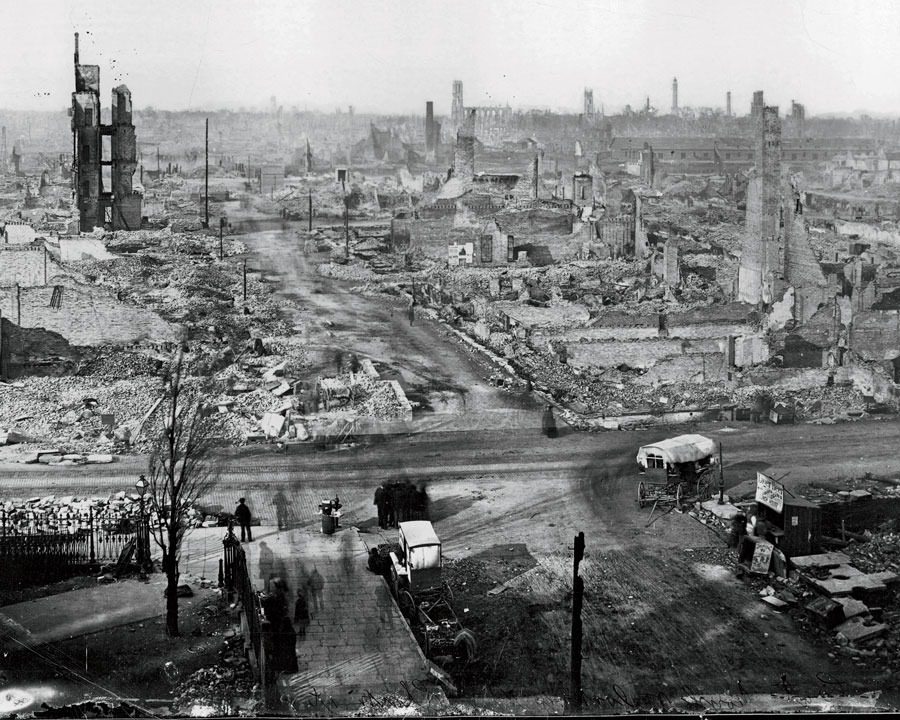
In the 19th century, the vast majority of buildings in Chicago were constructed of wood. In October 1871, the city was parched by severe heat and swept by gale-force winds. These conditions fueled a fire that rapidly engulfed Chicago, destroying everything in its path. From October 8 to 10, the inferno destroyed roughly 17,000 buildings and claimed the lives of at least 300 residents.
Following the disaster, martial law was declared in the city. Relief funds and humanitarian aid poured in from across the United States for those left homeless. Great Britain and Scotland also joined the relief efforts.
The primary lesson local authorities drew from the Great Fire was the urgent need to revise building regulations. Until then, most commercial spaces and residential houses in Chicago were built of wood, and rooftops were heavily burdened with commercial advertising structures.
American architect Frederick Law Olmsted noted that brick walls, along with disciplined police and firefighting teams, could have prevented such catastrophic destruction.
Chicago set to work almost immediately on rebuilding the city and drafting new fire safety codes. Business owners were determined not just to restore lost property, but to rebuild according to the highest modern standards. The city was entering a period of rapid industrialization.
Who Was William Le Baron Jenney?
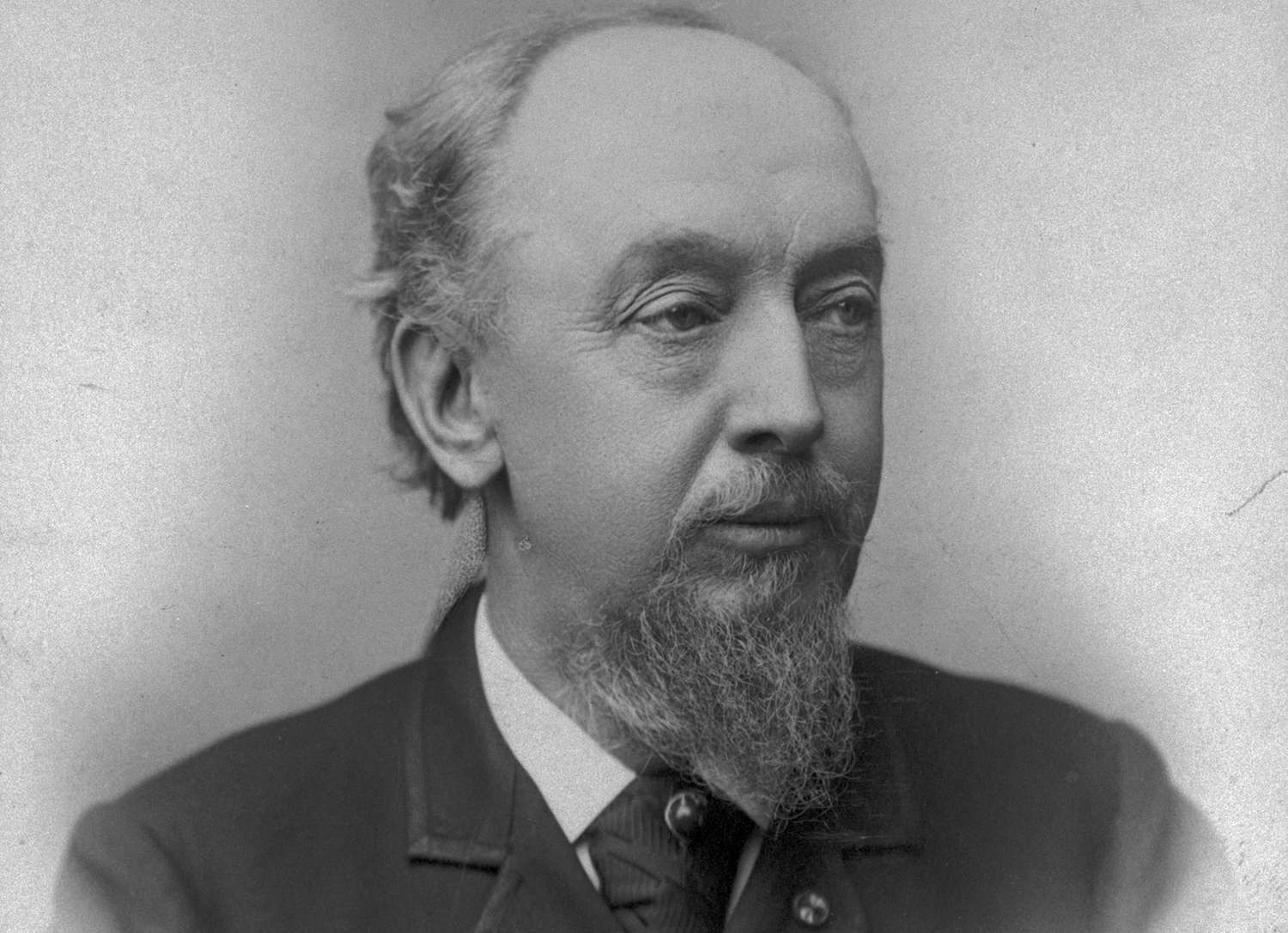
William Le Baron Jenney was born on September 25, 1832, in Fairhaven, Massachusetts. He received his preparatory education at Phillips Academy, an elite private institution. After graduating, the young man enrolled in the Lawrence Scientific School at Harvard University. However, Jenney left before completing the program, finding the curriculum lacking in depth.
The future engineer and architect transferred to the École des Beaux-Arts in Paris, graduating in 1856. Remarkably, one of Jenney’s classmates was Gustave Eiffel—the creator of the world-famous Eiffel Tower.
After completing his degree, Jenney worked for a time in Mexico before returning to the United States to join the Union Army, where he designed military fortifications. When the Civil War ended, William Le Baron Jenney moved to Chicago and worked on urban planning for the city’s parks and boulevard systems.
Notably, the landscape designs crafted by the talented engineer gained historic landmark status and remain under government protection today.
Alongside his park planning work in Chicago, William Le Baron Jenney served as a professor of architecture at the University of Michigan. He also extensively studied the theoretical and practical works of leading architectural figures of the era, such as Eugène Viollet-le-Duc and James Fergusson.
The Birth of the First Skyscraper: Chicago’s Home Insurance Building
After the Great Fire of 1871, Chicago urgently needed rapid, large-scale reconstruction. As a result, municipal authorities actively encouraged architectural experiments that could accelerate the city’s revival.
At the same time, there was strong demand among Chicago business owners for office and commercial properties built exclusively from fire-resistant materials. These modern challenges prompted William Le Baron Jenney and his team to pursue groundbreaking engineering solutions.
It was Jenney who conceived the idea of shifting the building’s structural load from bearing walls to an internal metal frame. A popular legend surrounds this breakthrough: one day, he noticed his wife place a heavy book on top of a lightweight wire birdcage. To the engineer’s surprise, the delicate structure easily supported the substantial weight. Jenney concluded that a building should feature a rigid internal skeleton of metal beams and columns to carry the weight of the floors and roof, while the exterior walls could serve as a light protective shell.
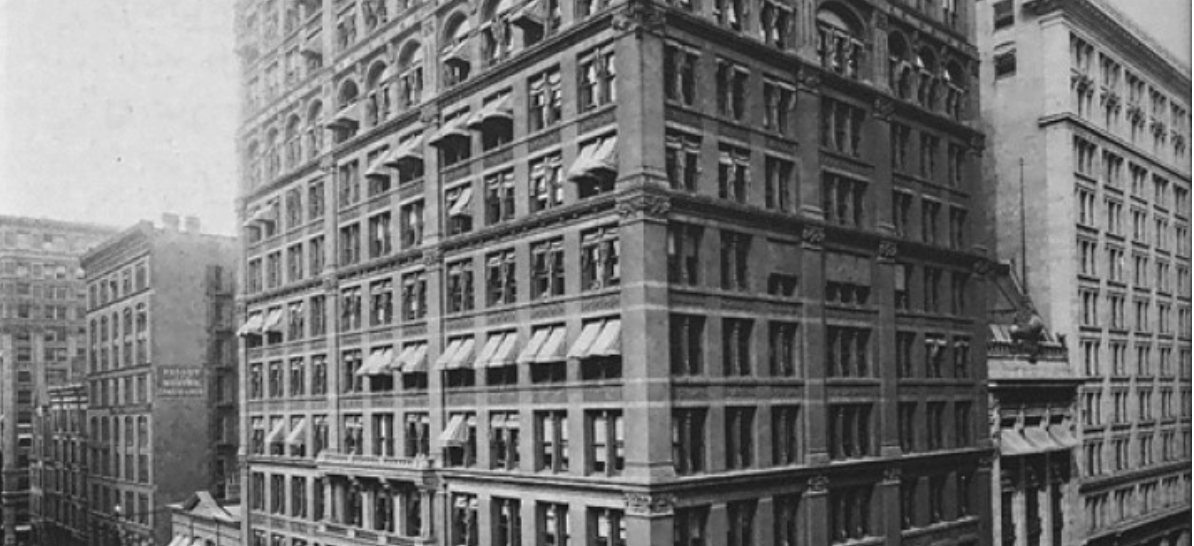
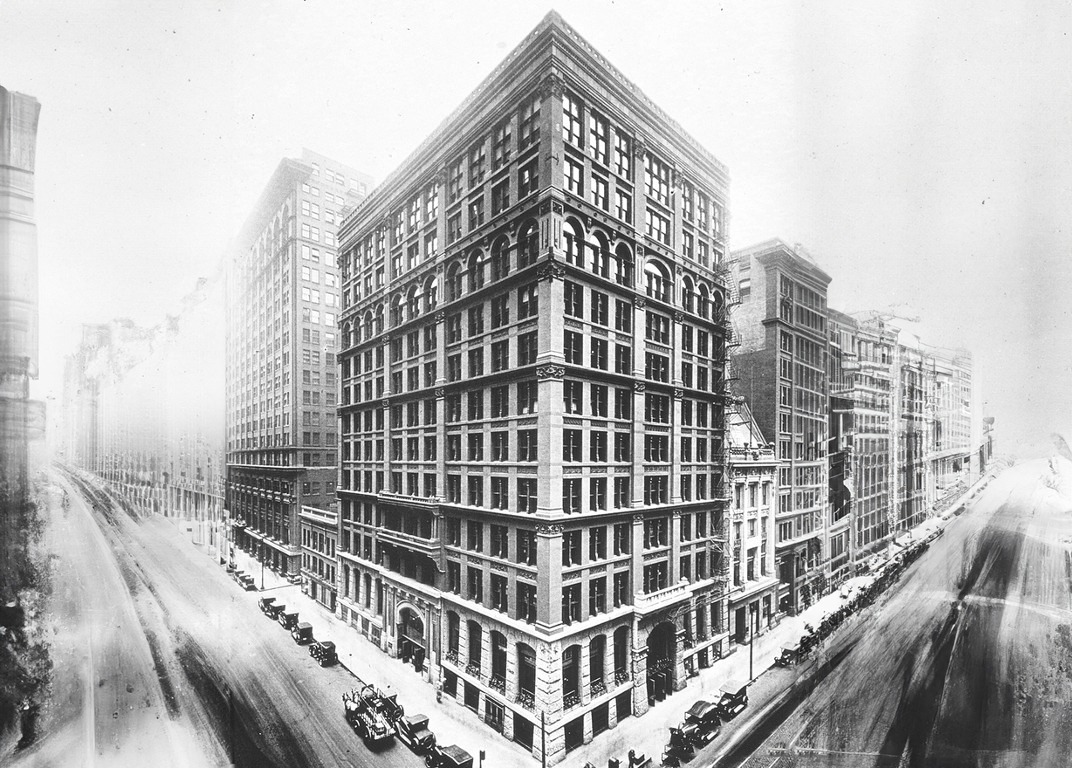
This novel structural design paved the way for skyscrapers, which soon came to define major American metropolises. In 1885, William Le Baron Jenney designed the Home Insurance Building—the world’s first skyscraper exceeding five stories.
The construction of this multi-story building marked the world’s first structural use of steel beams, though most of the framework was still fashioned from wrought and cast iron. A fireproof metal skeleton served as the core of the Home Insurance Building, making it the first high-rise to systematically implement fireproof materials.
The building rose to a height of 42 meters across 12 stories. By the 1930s, however, a new issue emerged: land values in downtown Chicago skyrocketed, and the Home Insurance Building was deemed outdated and too short for such prime real estate. Consequently, the historic skyscraper was demolished in 1931 alongside neighboring buildings.
In its place rose the 45-story Field Building. A commemorative plaque was installed on the structure to honor the Home Insurance Building as the birthplace of modern skyscraper engineering.
The Rise of the Chicago School of Architecture
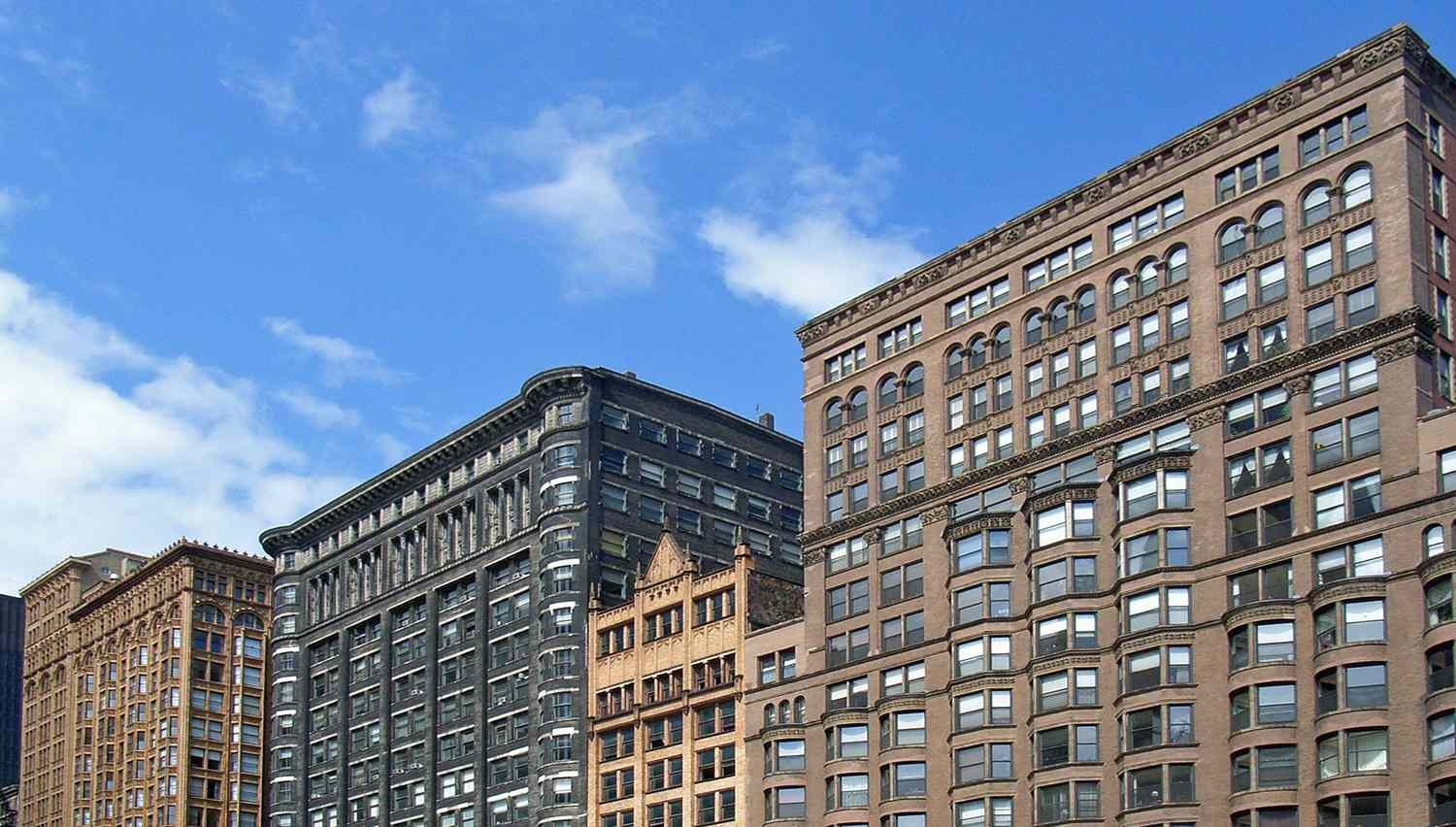
William Le Baron Jenney’s success in designing the world’s first skyscraper paved the way for a group of engineers and architects who became known as the Chicago School of Architecture. Alongside Jenney, prominent figures of this movement included Louis Sullivan, Henry Hobson Richardson, Frank Lloyd Wright, and Martin Roche.
The Chicago School developed a distinctive identity: rejecting excessive ornamental decoration in favor of functional vertical design and expansive glazed surfaces. In effect, this new movement laid the groundwork for modern urbanism and established the archetype for downtown business districts in global metropolises.
Yet William Le Baron Jenney remains the pivotal figure and recognized “father” of the Chicago School. He was the first to successfully utilize a metal framework that reduced building weight while unlocking unprecedented vertical height. Jenney’s architectural practice served as a masterclass for an entire generation of distinguished architects.
How Chicago’s Blueprint Reshaped American Metropolises
The successful development of skyscrapers in Chicago in the late 19th century became a model for other major US cities. Chicago was the first to demonstrate how municipal land could be maximized to build compact, high-density business districts.
Before the arrival of the Home Insurance Building, American cities were predominantly low-rise, consisting mainly of one- and two-story structures. Chicago’s experience transformed urban planning: cities gradually developed clear zoning, separating high-rise commercial centers from residential neighborhoods.
In addition, the skyscraper boom spurred the development of critical infrastructure, including safe passenger elevators and expanded municipal transit such as elevated railways.
The catastrophic Chicago fire also compelled US cities to overhaul safety standards and establish unified building codes. Across the country, legislation banned wooden structures in downtown cores. At the same time, the use of concrete, protected structural metal, and fire-resistant materials became mandatory in modern construction.
New York, San Francisco, Detroit, and Pittsburgh were among the first to adopt Chicago’s pioneering model, followed by cities across the United States.